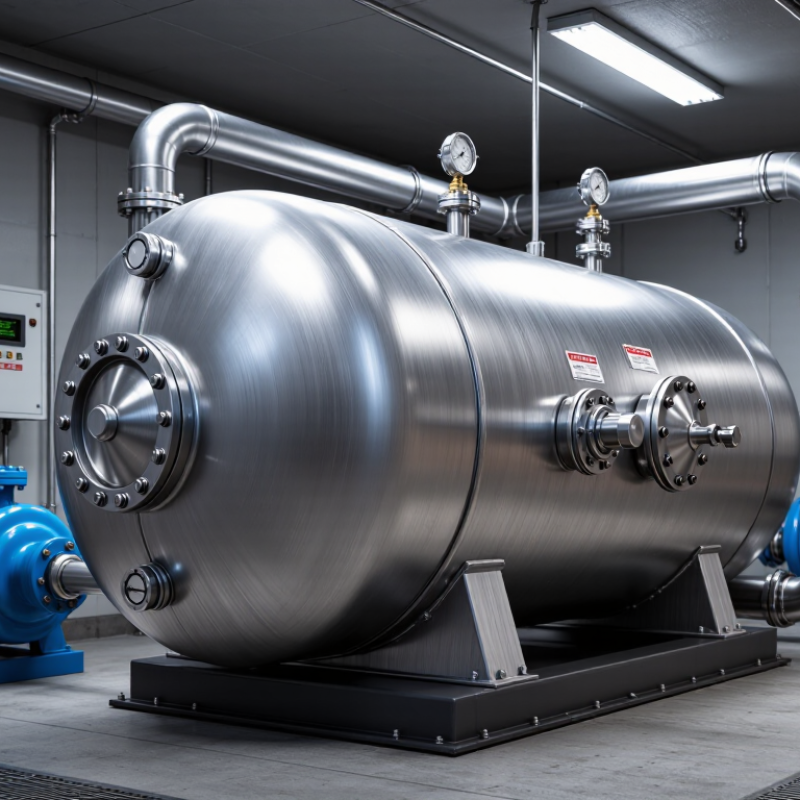
| Carbon steel with epoxy lining |
Internal epoxy coating; external painted or powder-coated steel |
8–16 bar
(116–232 psi) |
Usually about 4–60°C (39–140°F), subject to lining and membrane limits |
High mechanical strength; economical at larger sizes; widely available; good resistance to external impact |
Coating damage can cause corrosion; requires inspection of lining, welds, and external finish; heavier than composite alternatives |
Booster-pump systems, hydropneumatic tanks, irrigation, and general non-aggressive water service |
| Stainless steel |
Stainless steel wetted surface; may include an elastomeric diaphragm or bladder |
10–25 bar
(145–363 psi) |
Often about 4–80°C (39–176°F), depending on grade, seals, and membrane |
Strong corrosion resistance; smooth, cleanable surface; suitable for many hygienic water systems |
Higher purchase cost; chloride-rich or stagnant water can still cause localized corrosion; heavier than FRP |
Potable water, process water, coastal environments, food-service systems, and installations requiring a cleanable surface |
| FRP composite vessel |
Polyethylene liner with fiberglass-reinforced epoxy or resin outer shell |
6–10 bar
(87–145 psi) |
Commonly about 4–49°C (39–120°F) |
Lightweight; corrosion-resistant; easy to transport; suitable for many softening and filtration systems |
Lower pressure and temperature limits than many metal vessels; vulnerable to impact, ultraviolet exposure, and improper support |
Water softeners, filtration media, residential treatment, and low-to-moderate pressure applications |
| Polypropylene or reinforced thermoplastic |
Molded polypropylene, polyethylene, or other water-compatible thermoplastic |
4–10 bar
(58–145 psi) |
Often about 5–45°C (41–113°F) |
Very good resistance to many chemicals; low weight; no rust; simple handling |
Pressure capability decreases as temperature rises; creep and ultraviolet degradation must be controlled; not suitable for every gas or chemical |
Compact filtration, chemical-resistant water treatment, and low-pressure installations |
| Diaphragm or bladder pressure tank |
Replaceable or fixed EPDM, butyl, or equivalent elastomer separating water from compressed air |
Typically 6–16 bar
(87–232 psi) |
Commonly about 4–50°C (39–122°F); elastomer limits are critical |
Reduces waterlogging; minimizes air contact with water; stabilizes pump cycles; simplifies pre-charge adjustment |
Bladder fatigue, incorrect pre-charge, and incompatible disinfectants or chemicals can shorten service life |
Domestic water boosting, well systems, irrigation, and pump-cycle reduction |
| RO membrane pressure vessel |
FRP, fiberglass, or filament-wound shell with end closures and membrane-compatible seals |
Commonly 16–42 bar
(232–609 psi), depending on membrane class |
Frequently about 5–45°C (41–113°F) |
Designed to house RO elements; corrosion-resistant; available in multiple membrane lengths and diameters |
Requires correct membrane diameter, end-connection layout, seal material, and thrust-control arrangement; not interchangeable by size alone |
Brackish-water and seawater reverse-osmosis systems, pilot units, and industrial membrane skids |
 Hongke Qingneng