2026 Top Sphere Pressure Vessel Types for Buyers

Time:2026-11-02 Author:Liam
0%

A Sphere Pressure Vessel can look simple from a distance: a steel sphere raised on columns, with pipes, valves, and access points arranged around it. But buyers must look beyond its shape. Design pressure, operating temperature, stored medium, material grade, corrosion allowance, and inspection access all affect whether a vessel suits a specific site. Small details matter. A nozzle placed poorly can complicate maintenance; an unsuitable coating can shorten service life.

This guide compares the main types buyers may encounter in 2026, including differences in fabrication, materials, capacity, and intended operating conditions. It also outlines practical questions for reviewing supplier documentation, weld quality records, testing evidence, and lifecycle support. No single type fits every project. Site layout, climate, operating cycles, and future expansion deserve careful review, too. A low purchase price can be tempting, but it may not reflect installation or maintenance needs.

A verified industry expert should review and approve the quotation before publication: “[Insert a checked statement from a named Sphere Pressure Vessel specialist about matching vessel design to operating conditions.]” This attribution is intentionally left open; inventing a name or quotation would mislead buyers. Use the guide as a starting point, then confirm each specification with qualified engineering professionals and the vessel manufacturer.
2026 Top Sphere Pressure Vessel Types for Buyers

How Spherical Pressure Vessels Contain Pressurized Fluids

A sphere pressure vessel contains fluid by spreading internal pressure evenly across a curved shell. Unlike a cylinder, it has no long, flat sides where stress can concentrate as readily. For a thin spherical wall, the basic membrane-stress relation is σ = Pr/2t, where P is pressure, r is vessel radius, and t is wall thickness. This relationship appears in established pressure-vessel engineering practice; ASME Boiler and Pressure Vessel Code, Section VIII, provides requirements for vessel design and construction. Real designs also account for weld efficiency, corrosion allowance, temperature, and material strength. Geometry helps, but it does not replace inspection.

Inside a charged vessel, fluid pressure acts in every direction against the inner wall. The shell carries that load as tensile stress, while supports transfer the vessel’s weight and operating forces to its foundation. Engineers use fluid-property data, including pressure-volume-temperature values published by NIST, to estimate operating conditions and material behavior. A practical detail: a pressure gauge shows pressure at one point, not every local stress around a nozzle or weld. Those areas need careful design and examination. It is easy to treat a sphere as inherently safer; that assumption deserves a second look. Small flaws still matter.

Major Types of Sphere Pressure Vessels Available in 2026

In 2026, buyers can group sphere pressure vessels by stored medium and operating conditions. LPG spheres hold propane, butane, or mixed LPG under pressure. Ammonia spheres serve fertilizer and chemical facilities, while other process-gas spheres are specified for particular gases and design pressures. These services are not interchangeable. Material compatibility and temperature limits matter.

The WLPGA Statistical Review 2024 reports global LPG demand of about 330 million tonnes in 2023, underscoring the scale of LPG storage needs. That figure describes demand, not sphere installations, so it should not be treated as a vessel-market estimate. For design context, ASME BPVC Section VIII, Division 1 covers pressure-vessel construction; API 2510 addresses LPG installations. Buyers should verify the applicable design basis, inspection records, corrosion allowance, and local operating conditions.

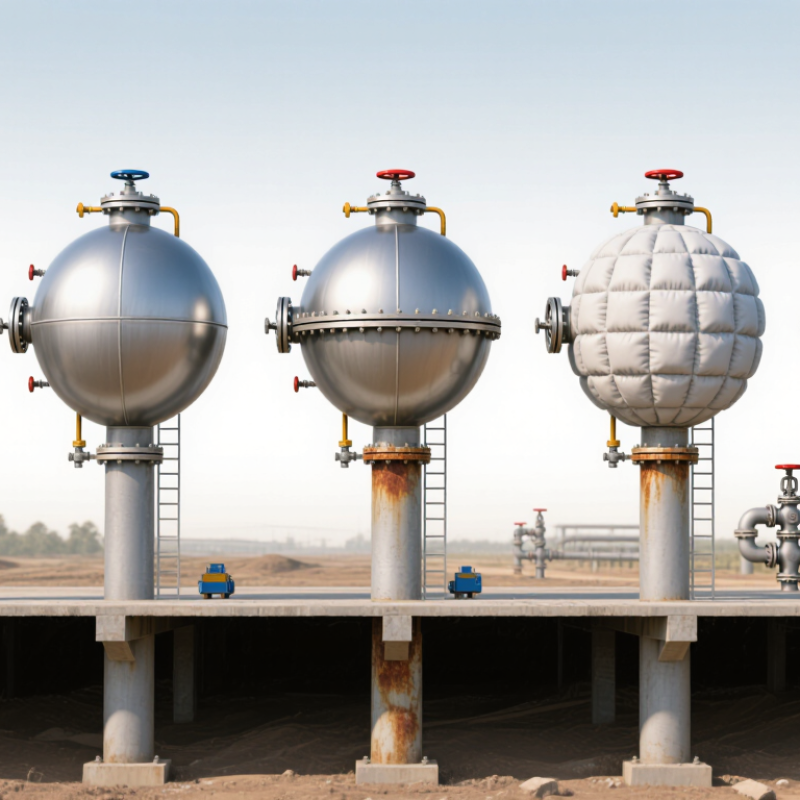
Construction details also distinguish options. A conventional sphere uses a welded shell supported by columns, with access platforms, valves, and piping arranged around the vessel. Insulation or protective coatings may suit specific climates and services, but they do not replace sound inspection planning. Capacity alone is a poor shortlist filter. Check working pressure, temperature range, stored product, and foundation loads together. A tidy comparison table can still hide important differences. Dig into the data sheet.

How Vessel Materials and Construction Methods Differ

2026 Top Sphere Pressure Vessel Types for Buyers
How Vessel Materials and Construction Methods Differ

A spherical vessel’s material affects weight, corrosion resistance, temperature limits, and maintenance needs. Carbon steel is common where the stored medium is not highly corrosive and operating conditions are well defined. Low-alloy steels can suit demanding pressure or temperature ranges, subject to the approved design. Stainless steel may resist corrosion better, but it is not automatically the best choice. Cost and compatibility matter.

Construction matters just as much. Many large spheres use formed steel plates joined by full-penetration welds. The number and placement of seams affect fabrication time and inspection access. Smaller or specialized vessels may use other manufacturing routes, depending on size and design requirements. Details vary. Buyers should review material certificates, weld procedures, heat-treatment records, and non-destructive examination results. These records help confirm that the finished vessel matches its specification.

Look closely at the service conditions before comparing quotations. A vessel exposed to changing temperatures, moisture, or corrosive contents may need different material choices than one used in stable service. Ask how the supplier controls plate forming, weld quality, and dimensional accuracy. Independent inspection can add confidence, but it cannot replace a clear design basis. I would also question unusually thin walls or vague inspection notes; lower cost can hide trade-offs that are easy to miss on paper.

2026 Top Sphere Pressure Vessel Types for Buyers - How Vessel Materials and Construction Methods Differ
Representative Type Typical Materials Common Construction Method Typical Service Considerations Key Buyer Checks
Carbon Steel Welded Sphere Pressure-vessel carbon steel plate, such as an applicable ASTM A516 grade, subject to the governing design code and project specification. Formed plate sections, often called gores or petals, are assembled and joined by qualified welding procedures. Welds commonly run along meridional and circumferential seams. A widely used option for storage services where the fluid, temperature, and corrosion conditions are compatible with carbon steel. Check design pressure and temperature, corrosion allowance, minimum design metal temperature, material traceability, weld examination requirements, and any required impact testing.
Low-Alloy Steel Welded Sphere Code-approved chromium-molybdenum or other low-alloy pressure-vessel plate; applicable grades depend on service and design conditions. Fabricated from formed plate sections and welded. Heat treatment may be required by the material, thickness, welding procedure, or construction code. May be considered for elevated-temperature service or other applications requiring properties beyond those of a selected carbon steel grade. Suitability is service-specific. Confirm code material approval, design temperature, heat-treatment requirements, weld consumables, hardness limits where specified, and inspection records.
Austenitic Stainless Steel Welded Sphere Pressure-vessel stainless plate, such as a suitable 304L or 316L grade where permitted by the applicable code and compatible with the process. Formed plate sections are welded using procedures and filler materials selected for the stainless grade and service. Surface condition and weld cleaning may be specified. Can provide improved general corrosion resistance over carbon steel in suitable environments. It is not immune to localized corrosion or stress-corrosion cracking. Evaluate the actual fluid chemistry, chlorides, operating temperature, corrosion mechanism, weld procedures, passivation or cleaning needs, and material certificates.
Duplex Stainless Steel Welded Sphere A suitable duplex stainless steel plate grade, such as UNS S32205 where code rules and project requirements allow. Formed plate sections are welded with controlled procedures designed to maintain appropriate weld and heat-affected-zone properties. May be selected for certain corrosive services where a combination of strength and corrosion resistance is required; performance depends on environment and fabrication quality. Verify code acceptance, service-specific corrosion testing if required, welding controls, heat input limits, ferrite or phase-balance requirements, and inspection scope.
Clad or Weld-Overlay Steel Sphere Carbon or low-alloy steel pressure-boundary base material with corrosion-resistant cladding or a welded corrosion-resistant overlay. Clad plate may be formed and welded with attention to the cladding layer; alternatively, a corrosion-resistant alloy is deposited as weld overlay on selected surfaces. Can combine a structural steel base with a corrosion-resistant process-contact surface when the selected lining system is suitable for the service. Check cladding or overlay thickness, continuity, bond or weld quality, repair procedures, corrosion allowance, examination requirements, and compatibility at seams and nozzles.
Nickel-Alloy Welded Sphere A suitable nickel alloy plate or weld-overlay system, selected for the specific corrosive or high-temperature environment. Fabricated from formed alloy plate or from a steel shell with alloy overlay. Material-specific forming, welding, and inspection procedures are important. May be considered for demanding services where a less costly material is not compatible. The appropriate alloy depends on the process chemistry and operating conditions. Confirm alloy compatibility against the complete process composition, design-code material status, welding and repair qualifications, procurement lead time, and lifecycle cost.

Buyer note: Large storage spheres are commonly fabricated from formed plate sections rather than selected by material alone. Final material, thickness, weld design, heat treatment, and examination requirements depend on the applicable construction code, design conditions, process service, and project specification.

Where Different Spherical Vessel Types Are Used

Spherical pressure vessels are most often used where plants need to store large volumes of pressurized liquid gas. At refineries and petrochemical sites, large field-erected spheres commonly hold liquefied petroleum gas, such as propane or butane. Their curved shells distribute internal pressure without corners, while the elevated shape leaves room for inspection and drainage equipment below. They are not automatically the best choice. A site with limited space or modest inventory may suit a different vessel layout.

Smaller shop-fabricated spheres can serve as pressure buffers or storage units in industrial gas and process systems. The right application depends on the fluid, operating pressure, temperature, and how often the vessel is filled and emptied. Cryogenic service needs special care: insulation, support design, and temperature control matter, and a conventional pressurized sphere is not a direct substitute for a purpose-built cryogenic tank. Details count. Buyers should check design pressure, corrosion allowance, inspection access, and foundation loads against the actual process data. A common purchasing mistake is comparing capacity alone; two vessels with the same volume may differ greatly in installation needs and maintenance access. A drawing can look convincing, yet still miss a practical site constraint.

How Buyers Compare Capacity, Pressure Ratings, and Compliance

Buyers should compare usable capacity, not just the vessel’s outside diameter. A sphere’s volume follows V = 4/3πr³, so small changes in radius can substantially increase storage volume. But capacity alone can mislead. Check the product’s density, operating temperature, fill limits, and required reserve volume. A drawing should show internal diameter and design conditions. Small details matter.

Pressure ratings depend on more than shape. Material strength, wall thickness, weld efficiency, temperature, and corrosion allowance all affect the permitted working pressure. ASME BPVC Section VIII, Division 1 (2023) covers many pressure vessels operating above 15 psig, subject to code exclusions. Compare each supplier’s maximum allowable working pressure with the actual operating and relief settings. Do not treat test pressure as a safe continuous operating rating.

For compliance, request material certificates, weld examination records, pressure-test documentation, and a readable nameplate. Check whether the selected code and edition are accepted by the installation jurisdiction. API 510 provides inspection guidance for vessels in service; its requirements may affect long-term inspection planning. I have seen buyers focus on the initial certificate and overlook access for future inspection. That can become an expensive design regret. A clear document package makes differences between otherwise similar bids easier to verify.

FAQS

How does a spherical pressure vessel contain pressurized fluid?

Pressure pushes outward in every direction. The curved shell distributes tensile stress around its surface. For a thin wall, stress is estimated as σ = Pr/2t, where P is pressure, r is radius, and t is wall thickness. Small flaws matter.

Is a sphere automatically safer than a cylindrical vessel?

No. Its shape can reduce stress concentration from broad, flat areas, but welds, nozzles, and material flaws still need attention. Geometry helps, but it is not a safety plan.

What fluids are commonly stored in spherical vessels?

Large spheres often store liquefied petroleum gas, including propane and butane. Other vessels may be designed for ammonia or specific process gases. These services are not interchangeable.

Where are spherical pressure vessels typically used?

Large, field-built vessels are common at refineries and petrochemical facilities. Smaller shop-built spheres can serve as storage units or pressure buffers. A compact site may need another layout.

What should buyers compare besides vessel capacity?

Check the stored fluid, working pressure, temperature range, corrosion allowance, and foundation loads together. Also review access for inspection and maintenance. Capacity alone can mislead.

Does a pressure gauge show stress across the whole vessel?

No. A gauge measures pressure at one point. Local stresses near a nozzle or weld may differ, so those areas require careful design and examination.

Can a conventional sphere be used for cryogenic storage?

Not as a direct substitute for a purpose-built cryogenic tank. Insulation, supports, and temperature control need special consideration. Details count.

Why do supports and foundations matter?

Supports transfer the vessel’s weight and operating forces to its foundation. Their design should match actual site conditions and vessel loads. A neat drawing can still miss a practical constraint.

Conclusion

A Sphere Pressure Vessel stores pressurized liquids or gases inside a rounded shell designed to distribute internal forces across its surface. This shape can help reduce stress concentrations compared with some other vessel designs, making spherical vessels an option for demanding storage and processing needs. In 2026, buyers can choose among different configurations and sizes, with suitable designs depending on the fluid, operating conditions, installation space, and intended service.

Construction materials and fabrication methods influence a vessel’s strength, corrosion resistance, maintenance needs, and expected service life. Spherical vessels may be used in industrial storage, process facilities, and other applications that require controlled containment. When comparing options, buyers should assess usable capacity, operating and design pressure ratings, material compatibility, inspection requirements, and applicable compliance documentation. Considering these factors together helps ensure that a vessel is appropriate for its specific site and operating conditions.

Liam

Liam

Liam is a dedicated marketing professional with a profound expertise in the industry, where he excels at highlighting the unique advantages of our core products. With a keen understanding of market trends and consumer needs, Liam frequently updates our company’s professional blog, providing......