Choosing the 2026 best Vacuum Pressure Vessel manufacturers requires more than comparing product prices or website claims. These vessels support demanding applications, including semiconductor processing, pharmaceutical freeze-drying, aerospace testing, and chemical production. Their walls may look motionless, yet every weld, flange, gasket, and inspection record carries operational responsibility.
Market reports provide useful direction, but they do not always separate vacuum pressure vessels from broader pressure equipment. Grand View Research tracks strong growth across the global vacuum pump market, while Fortune Business Insights reports continuing expansion in the wider pressure vessel sector. These figures indicate rising demand, not automatic manufacturer quality. Buyers still need traceable materials, documented vacuum-leak testing, fatigue calculations, and qualified welding procedures. ASME BPVC Section VIII and EN 13445 remain important reference frameworks, depending on project location and design requirements.
John F. O’Hanlon, a respected vacuum-technology author, emphasizes a practical principle: vacuum performance belongs to the complete system, not the pump alone. That observation matters when reviewing vessel suppliers. A polished chamber can still fail expectations if its seals, instrumentation, cleaning process, or evacuation design are poorly matched. Small details matter.
This guide evaluates leading manufacturers through engineering capability, certification practice, customization, testing transparency, delivery reliability, and after-sales support. The ranking is not perfect. Regional strengths, confidential project data, and changing 2026 capacity can distort comparisons. Therefore, readers should treat this overview as a qualified starting point, then verify drawings, standards, references, and acceptance tests before making a final procurement decision.
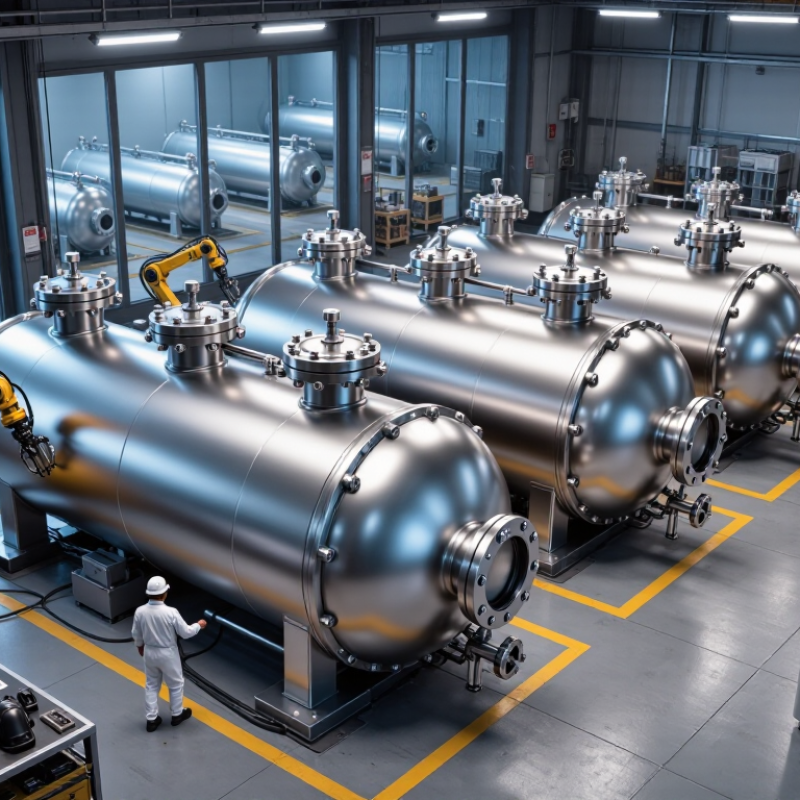
Vacuum Pressure Vessels Explained: Design, Materials, and ASME Section VIII
2026 Best Vacuum Pressure Vessel Manufacturers Worldwide?
Vacuum pressure vessels operate under external pressure, unlike ordinary storage tanks. Their shells can buckle suddenly when vacuum conditions are underestimated. ASME Section VIII, Division 1, requires engineers to address design pressure, temperature, materials, welding, inspection, and testing. Division 2 offers more detailed analysis for demanding services. These rules matter when comparing manufacturers for 2026 projects.
Material selection depends on fluid chemistry, temperature, vacuum depth, and cleaning cycles. Carbon steel can reduce cost, while stainless steel supports corrosion-sensitive applications. Reinforcing rings may strengthen large cylindrical shells. Finite element analysis can also reveal weak areas near nozzles and supports. Grand View Research estimated the global pressure vessel market at about US$48 billion in 2023, with continued growth expected through 2030. That growth does not guarantee better engineering. It may increase rushed fabrication.
Tips: Request the design calculations, material certificates, weld procedures, and non-destructive examination records. Confirm that external-pressure calculations follow the applicable ASME rules. Hydrostatic testing alone cannot prove every vacuum scenario. Ask for vacuum collapse assumptions, allowable tolerances, and inspection hold points. A manufacturer should explain these details clearly, not hide behind a certificate. My practical concern is simple: specifications often look complete, yet small nozzle loads or uneven support can remain overlooked. Review those details with an independent pressure-vessel engineer.
How to Rank 2026 Manufacturers: ISO 9001, PED, and Quality-Control Data
2026 Best Vacuum Pressure Vessel Manufacturers Worldwide?
How to Rank 2026 Manufacturers: ISO 9001, PED, and Quality-Control Data
A credible ranking should begin with evidence, not polished brochures. The ISO Survey 2022 reported more than 1.2 million ISO 9001 certificates worldwide. Yet certification alone proves only that a quality system exists. It does not guarantee reliable welds, vacuum stability, or accurate testing. Check the certificate scope, issuing body, expiry date, and factory location. Ask whether the manufacturer controls design, fabrication, inspection, and final release internally.
For vessels sold in Europe, verify compliance with the Pressure Equipment Directive 2014/68/EU. Request the applicable conformity route, risk category, technical documentation, and notified-body records. Review EN 13445 or another declared design code. Quality-control data should cover at least 24 months. Useful indicators include weld-repair rate, radiographic rejection rate, hydrostatic-test failures, leak-test failures, calibration delays, and nonconformity closure time. Always check the denominator. A “zero defect” claim may reflect limited production. That is uncomfortable, but important.
Tips: Request anonymized inspection logs, material certificates, welder qualifications, and calibration records. Compare results by vessel type and production batch. Interview the quality manager, not only sales staff. Visit the workshop if possible. Look for traceable heat numbers, clean vacuum ports, protected sealing surfaces, and clearly segregated nonconforming parts. Independent witness testing adds confidence. Still, even strong data can contain omissions, so leave room for technical review.
2026 Best Vacuum Pressure Vessel Manufacturers Worldwide? - How to Rank 2026 Manufacturers: ISO 9001, PED, and Quality-Control Data
| Rank Band |
Manufacturer Qualification Profile |
ISO 9001:2015 |
PED 2014/68/EU Capability |
Design-Code Coverage |
Material Traceability |
Welding Quality |
NDE and Testing |
Quality Score |
| Tier 1 |
Fully documented global pressure-vessel manufacturer |
Valid certificate; scope includes pressure equipment |
Design, manufacture, and conformity-assessment route documented |
EN 13445 and/or ASME Section VIII |
Heat number, MTR, and weld map linked to final dossier |
Qualified WPS/PQR and certified welders |
Hydrostatic or pneumatic test, VT, PT/MT, and UT/RT as specified |
90–100 |
| Tier 2 |
Established regional manufacturer with export experience |
Valid certificate; scope should be verified |
Available for selected products or projects |
One recognized design code consistently applied |
Material certificates available; full linkage requires confirmation |
Qualified procedures and welder records available |
Routine pressure testing and selected NDE documented |
75–89 |
| Tier 3 |
Capable custom fabricator requiring project-level verification |
Certificate status or scope needs confirmation |
Available only when specifically contracted |
Code selection depends on customer specification |
Basic material records available |
Welding qualifications must be reviewed before order |
Testing plan required for each purchase order |
60–74 |
| Tier 4 |
Supplier with incomplete third-party quality evidence |
Not verified or certificate scope is unsuitable |
No documented route before purchase |
Design basis not independently confirmed |
Incomplete or non-linked material records |
Welding qualification evidence unavailable |
Testing records incomplete or inconsistent |
Below 60 |
| Evaluation Dimension |
Weight |
Objective Evidence to Request |
Recommended Verification Method |
| Quality-management system |
15% |
Current ISO 9001 certificate, certification body, scope, issue date, and expiry date |
Check the certificate with the issuing certification body or accreditation database |
| Regulatory conformity |
15% |
PED category, conformity-assessment module, notified-body involvement, and EU Declaration of Conformity where applicable |
Review the technical file, nameplate data, declaration, and notified-body documentation |
| Engineering and design control |
15% |
Design calculations, allowable stress basis, fatigue assessment where required, drawings, and revision control |
Conduct a design-document review against the specified code and operating conditions |
| Materials and traceability |
15% |
Material test reports, heat numbers, receiving inspection, positive material identification where specified, and traceability map |
Sample raw-material records and traceability from purchase order to finished vessel |
| Welding and fabrication |
15% |
WPS, PQR/WPQR, welder qualifications, consumable control, preheat records, and weld maps |
Review qualification validity and compare weld records with production documentation |
| Inspection and non-destructive examination |
15% |
Inspection and test plan, visual inspection, PT/MT, UT/RT, dimensional inspection, and calibration records |
Verify personnel qualifications, inspection coverage, acceptance criteria, and equipment calibration |
| Pressure, vacuum, and leak testing |
10% |
Hydrostatic or pneumatic test record, vacuum test procedure, leak-test method, test pressure, hold time, and results |
Confirm test parameters against the design code, purchase specification, and approved test procedure |
Scoring principle: award points only for current, verifiable documentation. ISO 9001 certification supports quality-system evaluation but does not by itself prove pressure-vessel design compliance. PED applicability depends on the equipment category, fluid group, maximum allowable pressure, volume, and applicable conformity-assessment route.
Global Manufacturer Profiles: Cryogenic, Process, and High-Vacuum Expertise
2026 Best Vacuum Pressure Vessel Manufacturers Worldwide?
Choosing leading vacuum pressure vessel manufacturers requires more than comparing prices or catalog photos. The best suppliers demonstrate practical experience across cryogenic, process, and high-vacuum applications. Their engineering teams understand pressure cycles, thermal contraction, weld distortion, and contamination control.
For cryogenic vessels, manufacturers should show verified insulation performance and stable operation near extremely low temperatures. Ask for vacuum-jacket test results, material certificates, and documented leak checks. Small details matter. A poorly supported inner vessel can shift during transport or repeated filling. That risk is easy to underestimate.
Process vessel manufacturers need stronger customization skills. They should explain agitation loads, heating jackets, corrosion resistance, and cleaning access in clear technical language. High-vacuum specialists must control outgassing, surface finish, flange alignment, and helium leak rates. Reliable suppliers also provide drawings, inspection records, and traceable pressure-test data. Independent inspection can strengthen confidence.
A serious evaluation includes factory capability, not only promised specifications. Review welding qualifications, non-destructive testing methods, calibration records, and after-sales response times. Site audits often reveal practical weaknesses. Yet even a detailed checklist can miss issues. Installation conditions, operator training, and maintenance quality still influence vessel performance. No manufacturer gets every project detail right. Open communication helps expose those gaps before fabrication begins.
Key 2026 Metrics: Leak Rates Below 10⁻⁹ mbar·L/s and Pressure Ratings
2026 Best Vacuum Pressure Vessel Manufacturers Worldwide?
For 2026 procurement, leak performance deserves more attention than polished specifications. A target below 10⁻⁹ mbar·L/s indicates extremely tight containment, especially in high-vacuum service. ASTM E498/E498M describes helium leak-testing practices, while ISO 20485:2017 defines tracer-gas methods and measurement principles. These standards do not guarantee one universal pass value. The buyer must specify the method, calibration uncertainty, background level, and test temperature.
Leak rate is only half the evaluation. Pressure ratings should state maximum allowable working pressure, design pressure, test pressure, temperature limits, and vacuum differential. ASME BPVC Section VIII requires documented design and inspection controls for pressure vessels. A vessel rated at 10 bar does not automatically tolerate full vacuum or repeated pressure cycles. Wall thickness, weld geometry, flange loading, and material embrittlement can change the real safety margin. Small details matter.
Ask manufacturers for helium test records, pressure-test procedures, material certificates, weld inspection results, and traceable calibration data. A credible supplier should explain whether 10⁻⁹ mbar·L/s was measured before or after thermal cycling. That distinction is often missed. It should not be. Independent technical reviews increasingly favor lifecycle evidence over catalog ratings, although published comparisons remain inconsistent across industries. My practical concern is simple: a lower leak number can hide a weak test setup. Verify the chamber volume, detection limit, stabilization time, and acceptance criteria before comparing suppliers.
Buyer’s Checklist: Certification, Testing, Lead Times, and Total Cost of Ownership
Buying a vacuum pressure vessel in 2026 requires more than comparing quoted prices. Start with certification. Request the design code, material certificates, welding qualifications, and inspection records. Confirm whether the documentation matches the vessel’s actual serial number. Small inconsistencies can delay commissioning.
Testing should be visible, not merely promised. Ask for hydrostatic or pneumatic test procedures, leak-rate results, dimensional checks, and non-destructive examination reports. Witness points should be agreed before fabrication begins. A factory acceptance test can reveal valve problems, poor instrumentation, or unstable vacuum performance. It is easy to underestimate these details. That mistake becomes expensive later.
Lead time includes engineering approval, material sourcing, fabrication, testing, export preparation, and site installation. Obtain a schedule with realistic inspection hold points. Also examine total cost of ownership. Include electricity use, pump compatibility, gasket replacement, calibration, spare parts, cleaning access, and operator training. A cheaper vessel may consume more power or require frequent maintenance. Ask about warranty exclusions and local service response times. In my view, buyers should score suppliers against the same checklist, then record every assumption. Procurement teams often overlook downtime costs because they are difficult to calculate. Use a conservative estimate based on lost production hours. Safety margins matter. So does honest uncertainty.
FAQS
Review certificates, factory location, expiry dates, and certification scope. Brochures are not enough. Verify design, fabrication, inspection, and final release controls.
No. It confirms a quality-management system, not perfect welds or stable vacuum performance. Check production records and testing results.
Request the conformity route, risk category, technical file, and notified-body records. Confirm the declared design code and applicable requirements.
Request at least 24 months of data. Compare weld repairs, radiographic rejections, pressure-test failures, leak failures, calibration delays, and closure times.
A zero-defect claim may cover only a few vessels. Compare vessel types, production batches, and total inspected units. Small samples mislead.
Ask for material certificates, heat numbers, welder qualifications, inspection logs, and calibration records. Anonymized records can still show consistency.
Look for clean vacuum ports, protected sealing surfaces, and separated nonconforming parts. Check whether materials remain traceable during fabrication.
Cryogenic projects need insulation and leak-test evidence. Process vessels require clear answers about agitation, heating, corrosion, and cleaning access.High-vacuum work demands low outgassing, aligned flanges, controlled surfaces, and measured helium leak rates.
No. Installation, operator training, transport, and maintenance also affect performance. Technical review remains necessary. Some details will be missed.
Conclusion
This guide explains how a Vacuum Pressure Vessel is designed, manufactured, and evaluated for demanding industrial applications. It examines material selection, structural integrity, vacuum performance, and compliance with ASME Section VIII, while highlighting the importance of ISO 9001 systems, PED requirements, traceability, and documented quality-control procedures. Readers will learn how to compare manufacturers across cryogenic, process, and high-vacuum applications rather than relying on reputation alone.
The article also outlines key 2026 evaluation metrics, including pressure ratings, test procedures, dimensional accuracy, and leak rates below 10⁻⁹ mbar·L/s where appropriate. A practical buyer’s checklist covers certification verification, welding and non-destructive testing, inspection records, delivery schedules, maintenance support, and total cost of ownership. By combining technical performance, regulatory readiness, production reliability, and long-term operating value, buyers can make a more confident and objective selection.

 Hongke Qingneng