Choosing a Welded Pressure Vessel in 2026 requires more than comparing price, capacity, and delivery dates. The vessel must match the process, site conditions, maintenance plan, and expected operating life. A small mismatch in design pressure or temperature can create serious operational risks. Begin with the fluid, working volume, pressure range, temperature cycles, and corrosion behavior. These details guide material selection, wall thickness, nozzle placement, and weld design. They also influence inspection requirements and future repair costs.
Ask manufacturers for documented design calculations, qualified welding procedures, material certificates, and traceable inspection records. Non-destructive examination should be appropriate for the vessel’s service and risk profile. Look for evidence of hydrostatic testing, dimensional checks, heat-treatment control, and independent quality review where necessary. Supplier experience matters, especially when the vessel includes unusual alloys, large openings, internal coils, or repeated pressure cycles. A polished brochure is not enough. Real reliability lives in the records.
The best choice also considers installation access, insulation, drainage, supports, spare parts, and operator training. These practical details are easy to overlook during procurement. They often determine whether the vessel performs smoothly after commissioning. A perfect vessel does not exist. Even a well-designed unit may face changing feedstock, unexpected shutdowns, or harsher cleaning conditions. Therefore, compare technical evidence, not marketing promises, and involve qualified pressure-equipment engineers before approval. A careful decision today can reduce leaks, downtime, inspection surprises, and replacement costs tomorrow.
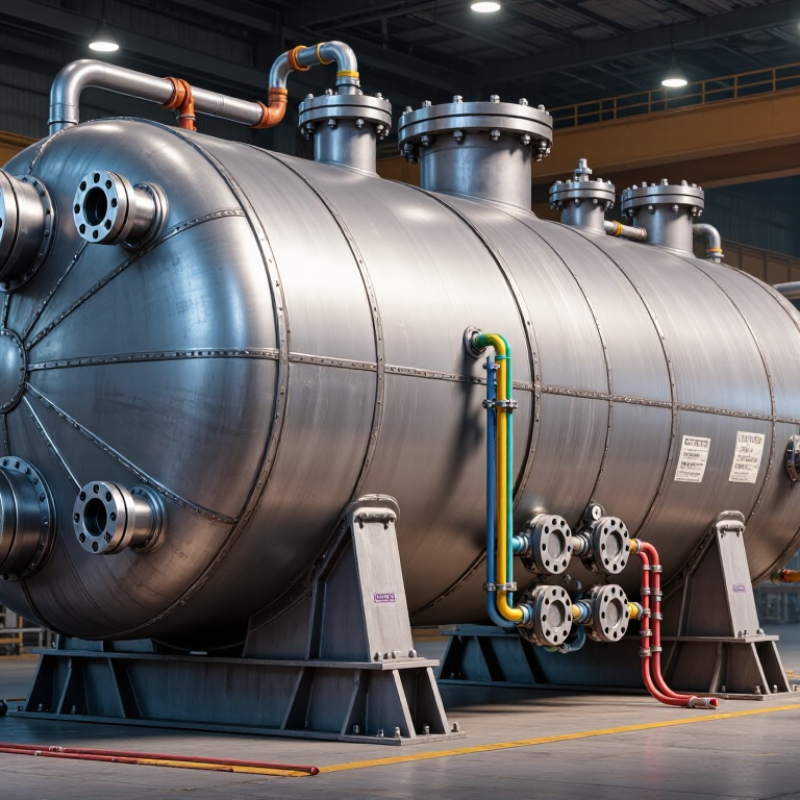
Before selecting a welded pressure vessel, define the actual service conditions. In Europe, the Pressure Equipment Directive applies when maximum allowable pressure exceeds 0.5 bar. That threshold is only the beginning. Record design pressure, normal pressure, temperature range, volume, fluid composition, and cyclic frequency. A vessel operating at 12 bar and 180°C needs different materials and testing from one holding compressed air at 8 bar and room temperature.
Fluid behavior can change the design quickly. NIST Chemistry WebBook reports carbon dioxide’s critical point at 7.377 MPa and 31.10°C. Near this condition, density and pressure may shift sharply. Water reaches a critical point at 22.064 MPa and 373.946°C, according to NIST data. These figures help engineers avoid treating every fluid as an ordinary liquid. Check vapor pressure, toxicity, flammability, corrosion, and possible contamination. Small impurities matter.
Size also affects risk. A 2 m³ vessel at 10 bar stores far more energy than a small laboratory receiver at the same pressure. Apply the applicable design code, such as ASME BPVC Section VIII or EN 13445, and document every assumption. Specify relief-device settings, corrosion allowance, weld examination, and hydrostatic test conditions. Do not rely on operating pressure alone. In practice, temperature excursions and repeated pressure cycles are often underestimated. I have seen “normal” data hide difficult startup conditions. Recheck them.
| Service Condition | Typical Values to Record | Practical Selection Guidance | Required Design Checks |
|---|---|---|---|
| Operating Pressure | More than 0.5 bar(g) or the applicable local pressure-equipment threshold. Record normal pressure, minimum pressure, maximum operating pressure, and pressure-vacuum cycles. | Select a welded vessel with a documented design pressure above the maximum credible operating pressure. Confirm whether the stated pressure is gauge pressure or absolute pressure. | Design pressure, hydrostatic or pneumatic test pressure, pressure relief set pressure, external-pressure resistance, fatigue from repeated cycles, and flange or nozzle loads. |
| Pressure Screening Band | 0.5–10 bar(g); 10–40 bar(g); above 40 bar(g). These are preliminary engineering bands, not universal legal classifications. | Lower-pressure vessels may be governed mainly by corrosion, vacuum stability, and fabrication quality. Higher-pressure service generally requires thicker walls, tighter inspection, and more detailed stress analysis. | Applicable pressure-vessel design code, weld category, joint efficiency, non-destructive examination, material allowable stress, and relief-system capacity. |
| Operating Temperature | Record minimum, normal, maximum, start-up, shutdown, upset, and cleaning temperatures in °C. Include heat-up and cool-down rates where known. | Choose materials and weld procedures that remain suitable across the complete temperature range, not only at normal operating temperature. | High-temperature strength, low-temperature toughness, thermal expansion, thermal shock, insulation effects, gasket compatibility, and brittle-fracture resistance. |
| Temperature Screening Band | Below −20°C; −20 to 120°C; 120 to 300°C; above 300°C. Actual limits depend on material grade, code, thickness, and service fluid. | Low-temperature service requires verified impact toughness. Elevated-temperature service may require creep, stress-relaxation, and oxidation assessments. | Minimum design metal temperature, maximum allowable working temperature, impact-test requirements, thermal-cycle fatigue, and material-specific allowable stresses. |
| Internal Volume | Record total geometric volume and working volume in litres or cubic metres. Common preliminary bands are below 0.1 m³, 0.1–1 m³, 1–10 m³, and above 10 m³. | Larger volume increases stored energy, liquid inventory, support loads, transport restrictions, inspection requirements, and the consequences of a release. | Pressure-volume classification, filling ratio, liquid expansion, shell stability, support and lifting loads, foundation loads, access openings, and relief-device sizing. |
| Filling Ratio and Free Space | Record normal liquid fill, maximum fill, vapor space, and any required surge volume. Do not assume that 100% filling is acceptable. | Provide adequate space for thermal expansion, foaming, level fluctuation, gas disengagement, and safe operation of the inlet and outlet connections. | Liquid thermal expansion, blocked-in heating, two-phase relief flow, level-control failure, overflow protection, and emergency depressurization. |
| Fluid State | Identify liquid, gas, vapor, two-phase mixture, slurry, or liquefied gas. Record density, viscosity, vapor pressure, and composition at design conditions. | Gas and two-phase service can store substantially more expansion energy than many liquid services. Slurries may require special inlet geometry and erosion allowance. | Relief-flow regime, mixing and dead zones, erosion, sedimentation, internal devices, drainability, venting, and nozzle reaction loads. |
| Fluid Hazard | Classify the fluid as non-hazardous, flammable, toxic, oxidizing, corrosive, environmentally harmful, or biologically active. | Hazardous fluids generally require tighter leak prevention, controlled venting, compatible seals, protective instrumentation, and documented emergency procedures. | Hazard classification, containment, ventilation, gas detection, discharge routing, fire protection, emergency isolation, and applicable regulatory conformity assessment. |
| Corrosion and Material Compatibility | Record pH, chlorides, dissolved oxygen, water content, contaminants, concentration, corrosion rate, and any galvanic-metal contact. | Specify a compatible pressure-boundary material, corrosion allowance, internal lining, cladding, or corrosion-resistant weld overlay when justified by the service assessment. | Uniform corrosion, pitting, crevice corrosion, stress-corrosion cracking, hydrogen damage, erosion-corrosion, weld sensitization, and inspection intervals. |
| Cyclic and Transient Service | Record the expected number of pressure and temperature cycles, cycle frequency, start-up frequency, vacuum events, and emergency trips. | A vessel designed for steady pressure may not be suitable for frequent cycling. Select the design based on the complete pressure-temperature history. | Fatigue analysis, local stress at nozzles and supports, thermal gradients, weld-detail classification, crack-growth risk, and inspection planning. |
| Welding and Inspection | Define material certificates, qualified welding procedures, welder qualifications, heat treatment requirements, and the required non-destructive examination. | Use a qualified fabrication route with traceable materials and controlled welding. Inspection scope should match pressure, temperature, fluid hazard, and fatigue risk. | Visual examination, surface examination, volumetric examination where required, dimensional checks, pressure testing, weld repairs, heat treatment records, and final documentation. |
| Applicable Regulations and Design Code | Identify the installation country, jurisdiction, pressure-equipment category, design code, operating site rules, and inspection authority requirements. | Select the code before finalizing dimensions or materials. Common frameworks include ASME Section VIII and EN 13445, together with applicable local legislation. | Code calculations, conformity assessment, nameplate data, relief protection, operating instructions, inspection access, documentation, and periodic requalification. |
They generally apply when the maximum allowable pressure exceeds 0.5 bar. Classification uses pressure, volume, fluid group, and equipment category. Actual service conditions matter more than shop-test pressure.
Check the destination country, assessment requirements, and required inspection records. A larger vessel may need independent conformity review. The cheapest route is not always the simplest.
Review design pressure, temperature, corrosion allowance, relief settings, materials, and cyclic loading. Consider future operating changes. A neat drawing can still hide a weak fatigue assumption.
It shows every pressure-retaining seam and the planned examination coverage. Review shell seams and nozzle joints separately. A perfect longitudinal weld cannot rescue a poor nozzle connection.
Joint efficiency may be 1.00, 0.85, or 0.70, depending on weld type and examination coverage. Sampling can reduce cost. It may also miss repeated defects.
Check material group, thickness, temperature, heating rate, and holding time. Review furnace charts and thermocouple locations. One missing sensor matters.
No. It confirms welding variables, filler materials, preheat, interpass temperature, and test results. Design acceptance and weld inspection remain separate responsibilities. Paperwork is evidence, not proof.
Confirm the test pressure, water temperature, calibrated gauges, holding time, and leakage observations. Pressure is often near 1.3 times the allowable working pressure, but not universally. Verify the exact calculation.
Request material certificates, heat numbers, weld maps, procedures, welder qualifications, examination reports, dimensional checks, test charts, and calibration records. Digital files need revision control and readable timestamps. Missing paperwork can delay repairs for days.
Certification does not guarantee every engineering assumption is suitable. Review fatigue, corrosion, weld repairs, relief settings, and final nameplate details. Some vessels pass every checklist and still deserve another look.
Choosing a Welded Pressure Vessel in 2026 begins with clearly defining its service conditions. Confirm that the operating pressure is above 0.5 bar, then evaluate design pressure, temperature range, internal volume, and the properties of the contained fluid. Select an appropriate compliance route, such as ASME Section VIII or PED 2014/68/EU, based on the installation location, risk category, and applicable regulatory requirements.
Material selection should match the environment: carbon steel for many general applications, stainless steel for corrosive or hygienic duties, and 3.5% nickel steel for cryogenic service. Weld quality must be verified through suitable NDE coverage, documented joint efficiency, required PWHT, and qualified procedures and personnel under ASME Section IX. Before delivery, confirm pressure testing, typically a hydrotest at approximately 1.3 times the MAWP, together with complete 2026 documentation, including drawings, material certificates, weld records, inspection reports, test results, and compliance certification.

 Hongke Qingneng