The global process equipment industry is demanding safer, cleaner, and longer-lasting vessels. Inox Pressure Vessel technology supports food processing, pharmaceuticals, chemicals, water treatment, and energy applications. Stainless steel offers corrosion resistance, hygienic surfaces, and dependable performance under controlled pressure. These qualities matter where product purity and maintenance costs directly affect production.
Market reports show why manufacturers deserve closer evaluation. Grand View Research’s Stainless Steel Market Size, Share & Trends Analysis Report, 2023–2030, identifies strong demand growth across industrial and processing applications. MarketsandMarkets’ Pressure Vessel Market report estimates continued expansion, supported by chemical production, power generation, and storage infrastructure. These reports do not measure every Inox Pressure Vessel supplier equally. However, they reveal a clear investment trend.
Quality cannot be judged by polished photographs alone. A credible manufacturer should demonstrate material traceability, qualified welding procedures, non-destructive testing, and documented pressure testing. ASME Section VIII, PED requirements, ISO 9001 systems, and project-specific specifications may also influence purchasing decisions. Certification must be verified for the actual factory and vessel design.
The following Top 10 Inox Pressure Vessel Manufacturers Worldwide list considers engineering capability, manufacturing scale, industry experience, customization, quality controls, and international project support. Some companies appear stronger in pharmaceutical fabrication. Others perform better on large industrial vessels. No ranking is perfect. Supplier capacity can change, and public information may remain incomplete. Buyers should still review drawings, inspection plans, references, and after-sales service before making a final decision. Small details matter. A poorly documented weld can create larger costs later.
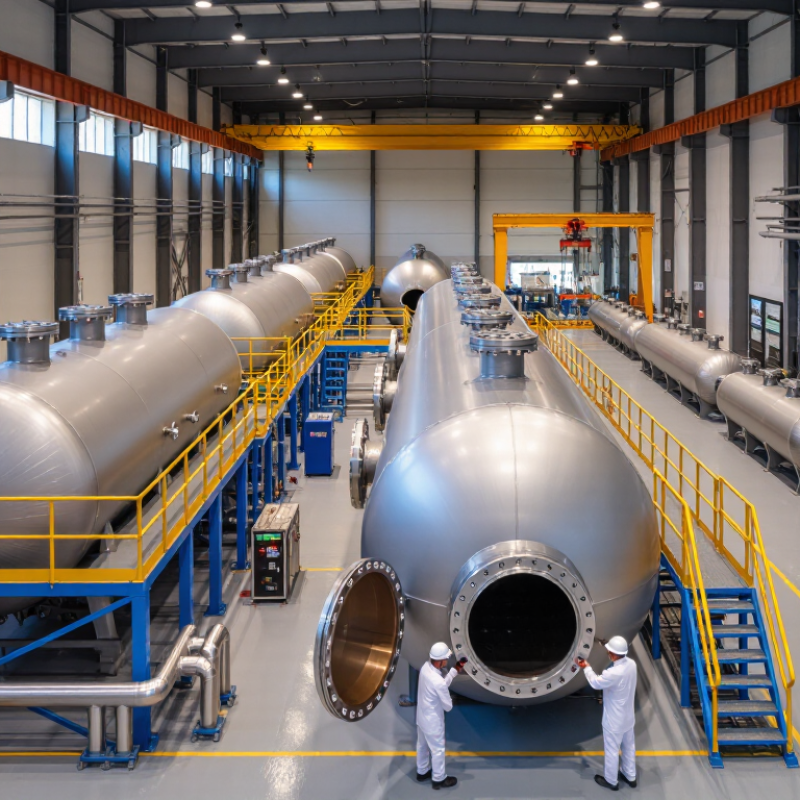
The global inox pressure vessel market is shaped by food, chemical, pharmaceutical, and energy demand. A credible top-ten comparison should examine more than production volume. It should test material traceability, welding control, inspection records, and export experience.
304 stainless steel suits many clean, low-chloride services. 316L offers stronger resistance in chloride-bearing environments, but it is not automatically the better choice. According to World Stainless production data, global crude stainless steel output remains near 60 million tonnes annually. That scale supports broad material availability, yet quality can vary between heats. Positive material identification matters.
HS 7309 covers iron or steel reservoirs, tanks, and similar containers exceeding 300 litres. Classification does not prove pressure performance. Buyers should confirm design pressure, temperature range, corrosion allowance, and nozzle reinforcement. ASME Section VIII, Division 1 remains a widely used framework for pressure-vessel design, fabrication, examination, and testing. A vessel may still require additional project specifications.
Look closely at orbital or manual weld procedures. Ask for WPS, PQR, welder qualifications, radiography or ultrasonic records, and hydrostatic test evidence. Surface finish also matters; trapped iron particles can damage hygienic service. Market outlooks from Grand View Research and Fortune Business Insights indicate continuing pressure-vessel growth, driven by process industries and energy investment. Their forecasts differ, which deserves caution. Forecasts are not purchase guarantees. A polished shell can hide weak documentation, uneven passivation, or poor after-sales support.
| Rank | Anonymous Manufacturer Profile | Primary Market Region | Typical Vessel Category | 304 Stainless Steel | 316L Stainless Steel | HS 7309 Scope | ASME Section VIII Scope | Common Industries Served |
|---|---|---|---|---|---|---|---|---|
| 1 | Profile 01 | East Asia | Large welded process vessels | Available | Available | Welded vessels and tanks exceeding 300 L | Design, fabrication and inspection to VIII-1 | Chemical, food processing, water treatment |
| 2 | Profile 02 | Western Europe | Hygienic storage and mixing vessels | Available | Preferred for corrosion resistance | Fabricated stainless-steel tanks over 300 L | VIII-1 fabrication with documented traceability | Pharmaceutical, dairy, biotechnology |
| 3 | Profile 03 | North America | Horizontal and vertical pressure vessels | Available | Available | Industrial reservoirs and pressure vessels | ASME VIII-1 design and Authorized Inspector review | Oil and gas, utilities, industrial processing |
| 4 | Profile 04 | South Asia | Custom-engineered storage vessels | Available | Available | Large non-fired welded tanks | VIII-1 calculations and welding documentation | Fertilizer, chemicals, water and energy |
| 5 | Profile 05 | Southeast Asia | Low- and medium-pressure process tanks | Common | Common | Stainless-steel tanks with welded construction | Available for specified pressure-duty projects | Edible oils, beverages, wastewater treatment |
| 6 | Profile 06 | Middle East | Corrosion-resistant utility vessels | Available | Preferred in chloride service | Industrial tanks over 300 L capacity | VIII-1 engineering and nondestructive examination | Desalination, petrochemicals, utilities |
| 7 | Profile 07 | Northern Europe | Sanitary pressure and fermentation vessels | Available | Widely specified | Welded stainless-steel tanks above 300 L | VIII-1 pressure design with surface-finish controls | Brewing, food, pharmaceutical processing |
| 8 | Profile 08 | Eastern Europe | Heavy-duty fabricated vessels | Available | Available | Welded tanks and reservoirs exceeding 300 L | ASME-aligned calculations and quality records | Industrial gases, chemicals, district energy |
| 9 | Profile 09 | Latin America | Process and buffer vessels | Available | Available for demanding media | Large welded stainless-steel containers | Project-specific VIII-1 compliance | Mining, food processing, pulp and paper |
| 10 | Profile 10 | Oceania | Special-purpose pressure and storage vessels | Available | Available | Non-fired welded vessels over 300 L | VIII-1 documentation where contractually specified | Water, dairy, chemical and renewable-energy projects |
Compare production capacity, regional service, qualified welders, inspection systems, and delivery support. Factory size alone proves little. A large network can still produce uneven workmanship.
Request design pressure, operating temperature, vessel volume, material grade, nozzle layout, and installation limits. Check vacuum service too. These details reveal whether the vessel fits real operating conditions.
304L suits many general process fluids. 316L performs better around chlorides and chemical contamination. Duplex grades provide higher strength, but welding control becomes more demanding.
No. Vessel volumes may range from about 1 m³ to over 1,000 m³. Bigger equipment needs stronger transport planning, welding control, and inspection. Capacity is not a quality certificate.
Ask for mill certificates, weld maps, material identification records, and hydrostatic test results. Also request visual, dye penetrant, ultrasonic, or radiographic testing records. The paperwork should match the actual vessel.
It can reveal surface cracks, hidden weld flaws, and material mix-ups without cutting the vessel apart. Critical welds may need complete radiographic or advanced ultrasonic examination. Inspection costs money, but repairs cost more.
A smoother finish can support hygiene and reduce areas where contaminants collect. It may also improve resistance during repeated cleaning. The ideal finish depends on the process, not appearance alone.
Be cautious when a supplier offers universal performance claims or vague inspection evidence. Request repair rates, heat-treatment records, and rejected-weld statistics. Published comparisons often omit these uncomfortable details.
Review local engineering coverage, response times, spare-part planning, and installation assistance. A nearby technical team can verify pressure ratings and nozzle positions. Promises are weaker than documented field experience.
This article presents a practical overview of the global Inox Pressure Vessel manufacturing sector, focusing on equipment made from 304 stainless steel, 316L stainless steel, and related materials classified under HS 7309. It explains how leading manufacturers can be compared through international trade data, recognized certifications, production capacity, and export coverage, while avoiding brand-specific promotion. The ranking emphasizes measurable industrial capability and global market reach.
The technical comparison examines design pressure, vessel volume, material selection, fabrication methods, and non-destructive testing requirements. It also reviews compliance with ASME Section VIII, PED 2014/68/EU, and ISO 9001, alongside weld quality, inspection procedures, and traceability. Together, these factors help buyers evaluate safety, durability, manufacturing consistency, and regulatory readiness when selecting pressure vessels for chemical processing, food production, energy, water treatment, and other demanding industrial applications.

 Hongke Qingneng