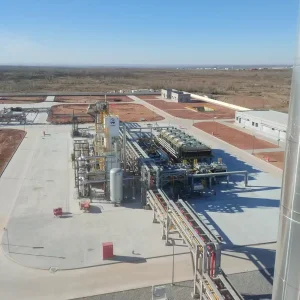
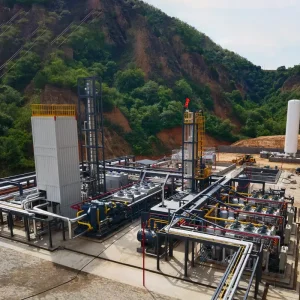
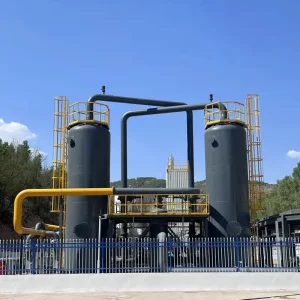
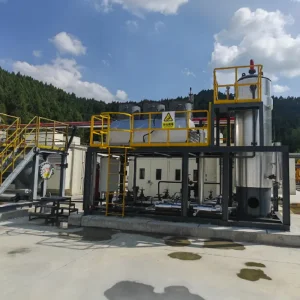
High-efficiency cryogenic systems tailored for regional oil & gas monetization, gas treatment, and environmental safety.
Industrial liquefaction plants represent the pinnacle of thermodynamic engineering, requiring the precise control of cryogenic temperatures, phase changes, and pressure thresholds. At the heart of a modern liquefaction facility is the refrigeration cycle, which cooling natural gas, biomethane, or industrial tail gas to cryogenic temperatures (typically -162°C for methane at atmospheric pressure).
As prominent liquefaction plant manufacturers and factory suppliers in Bangkok, we provide systems built upon the Single Mixed Refrigerant (SMR) process and the Nitrogen Expansion Cycle. The SMR process utilizes a customized mixture of hydrocarbons (methane, ethane, propane, butane) and nitrogen. By continuously condensing and evaporating this mixture in a series of highly optimized plate-fin heat exchangers (PFHE), we achieve supreme thermodynamic efficiency. This reduces the Specific Power Consumption (SPC) to as low as 0.28–0.32 kWh/Nm³ of liquefied gas, depending on the feed gas composition and local ambient conditions.
“Thermodynamic optimization in cryogenic systems hinges on minimizing irreversibilities. By pairing advanced mixed working mediums with multi-stream plate-fin heat exchangers, we match the cooling curves of the process gas and refrigerant to an unprecedented degree.” — Dr. Sun Zhaohu, Founder & Chairman.
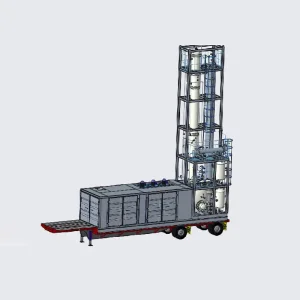
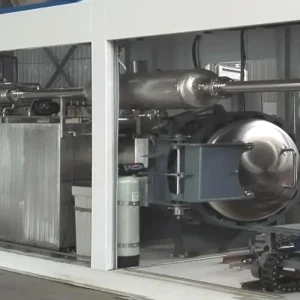
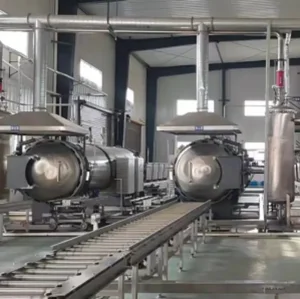
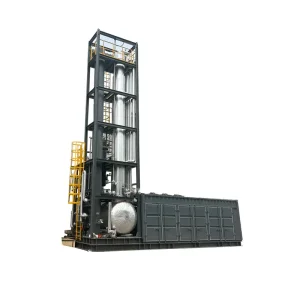
In the past, liquefaction plants required extensive civil engineering, prolonged site construction timelines, and complex field testing. Our manufacturing methodology focuses heavily on skid-mounted assembly. By designing modular, factory-tested skids, we shift 90% of the construction and quality assurance testing to our controlled factory floor.
For industrial operators in Bangkok and surrounding areas, this skid-mounted approach mitigates local installation risks, minimizes the footprint on soft clay delta soils, and decreases commissioning timelines from months to weeks. Each skid comprises structured packaging for deacidification, molecular sieve dehydration units, heavy hydrocarbon removal filters, the cold box assembly, and variable-frequency compressor units.
Bangkok serves as the industrial gateway to Thailand and the broader ASEAN region, anchored by the Eastern Economic Corridor (EEC) initiatives. Historically reliant on pipeline natural gas from domestic fields in the Gulf of Thailand and imports from neighboring Myanmar, the regional energy landscape is shifting rapidly towards Liquefied Natural Gas (LNG) imports, local peak-shaving solutions, and green biogas recovery.
The demand for decentralized liquefaction technologies in Thailand is driven by several key factors:
Globally, the liquefaction industry is undergoing a structural transition. As energy sectors target decarbonization, the utilization of small-to-medium-scale liquefaction plants (10,000 to 300,000 Nm³/day) has surged. Operators now prioritize modular capital investment over multi-billion-dollar megaprojects. This shift aligns perfectly with our company’s technical expertise in compact, mobile, and highly adaptable environmental and cryogenic units.
To assist engineering procurement managers in selecting the ideal technology route for their specific Bangkok installation, the table below outlines the primary metrics comparing the two leading cryogenic refrigeration pathways:
| Engineering Metric | Single Mixed Refrigerant (SMR) | Nitrogen Expansion (Claude Cycle) |
|---|---|---|
| Specific Power Consumption | 0.27 - 0.35 kWh/Nm³ (Lower Energy Requirement) | 0.45 - 0.55 kWh/Nm³ (Higher Energy Requirement) |
| Process Complexity | Moderate; requires refrigerant storage and blending | Low; uses nitrogen from ambient air as refrigerant |
| Capital Expenditure (CAPEX) | Higher initial component cost | Lower initial cost; simplified skid configuration |
| Best Suited For | Continuous, base-load LNG plants > 50,000 Nm³/d | Frequent start/stop, peak-shaving, and small-scale plants |
| Maintenance Profile | Requires skilled monitoring of refrigerant ratios | Extremely simple; clean gaseous nitrogen loop |
Hebei Hongke Qingneng Environmental Protection Equipment Co., Ltd. is not merely a manufacturer; we are an engineering R&D institute at heart. Backed by a registered capital of 78 million yuan and situated in the Sanhe Economic Development Zone, Langfang City, our engineering center leverages direct academic partnerships with Tsinghua University and the Institute of Physics and Chemistry Technology, Chinese Academy of Sciences (CAS).
Our technical leadership team consists of recognized cryogenic pioneers:
PhD from the Institute of Physics and Chemistry Technology, CAS. National Senior Engineer. Recipient of the Special Prize of Technological Invention of Chinese Society of Refrigeration (2015) and Beijing Science and Technology Award (2016). Presided over 20+ proprietary intellectual property programs.
Senior Researcher at CAS. Authored 24 peer-reviewed academic papers (11 SCI/EI indexed) and holds multiple invention patents. Winner of the Silver Medal at the 19th China International Industry Expo (2017) and Beijing Science and Technology Award.
Doctor of Engineering from CAS. Renowned specialist in phase change heat transfer characteristics and flow dynamics of mixed working mediums. Spearheaded the design of modular skid-mounted natural gas liquefaction systems deployed in challenging environments.
Deploying thermal, environmental, and cryogenic equipment in Bangkok's petrochemical zones requires adherence to stringent national safety codes. Our operations are fully integrated with international standards, holding crucial licenses that guarantee safety, structural integrity, and durability:
Detailed answers to critical engineering, installation, and process questions regarding cryogenic systems.
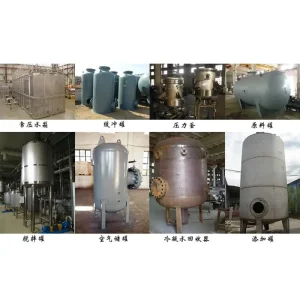
Extending our engineering expertise to custom pressure vessels, environmental waste treatment, and exhaust gas recovery systems.
 Hongke Qingneng