 Hongke Qingneng
1. Industrial Paradigm Shift: Defining Best-in-Class Heating Pressure Vessels
In modern process industries—spanning petrochemical refining, cryogenics, natural gas liquefaction, and bio-hazardous waste processing—the demand for highly reliable heating pressure vessels has shifted from basic pressure containment to highly sophisticated thermal-fluidic containment networks. Today's industrial heating pressure vessels must survive severe cyclical thermal stresses, aggressive corrosion, and variable operating pressures. Selecting a manufacturer is no longer just about wall thickness calculations; it requires evaluating the design engineer's mastery over thermal thermodynamics, structural fatigue, and fluid dynamics.
To establish true E-E-A-T (Experience, Expertise, Authoritativeness, and Trustworthiness), global procurement teams examine the physical metallurgy, welding technologies, and non-destructive examination (NDE) methods used by factory suppliers. A2-class pressure vessel manufacturing credentials serve as the baseline, representing the capacity to design and construct thick-walled containment units that operate under extreme pressures and heat ratings.
2. Academic Excellence & R&D Architecture: The Tsinghua & CAS Legacy
The technical foundation of Hebei Hongke Qingneng Environmental Protection Equipment Co., Ltd. (established June 2021, registered capital 78 million yuan) is anchored by a high-caliber R&D team from elite Chinese research institutions, including Tsinghua University and the Institute of Physics and Chemistry Technology of the Chinese Academy of Sciences (CAS). This academic integration translates molecular-level thermal dynamics and cryogenic research into tangible industrial operations.
This collaboration has driven progress in multi-component mixed-refrigerant cycles (MRC), phase-change heat transfer, and low-temperature boundary layer mechanics. By resolving the complex physics of two-phase flow in microchannel configurations, the engineering team has optimized heating and cooling profiles in pressure vessels, preventing localized stress concentrations and catastrophic thermal shock.
3. Technical Roadmap: Metallurgy, Structural Design, and Manufacturing Excellence
A high-performance heating pressure vessel depends on strict quality controls across its entire design and fabrication process. Below is the structural roadmap detailing our engineering priorities:
| Engineering Parameter | Standard Practice | Advanced Hongke Qingneng Standard |
|---|---|---|
| Material Selection | Standard SA-516 Gr. 70 Carbon Steel | Super Duplex, SA-240 316L, and Titanium-Stabilized Alloys |
| FEA Structural Analysis | 1D/2D Static calculations | 3D Transient thermal-mechanical Finite Element Analysis (ANSYS) |
| Welding Quality Control | Manual SMAW / Basic SMAW | Automated Narrow-Gap SAW & Orbital GTAW with real-time tracking |
| Non-Destructive Testing | Spot Radiographic Testing (RT) | 100% Phased Array Ultrasonic Testing (PAUT) & Time-of-Flight Diffraction |
Our thermal calculation models use transient Finite Element Analysis (FEA). This ensures that when the vessel transitions during start-up, shut-down, or sudden thermal excursions, the rate of temperature change across varying wall thicknesses remains within safe limits. This design practice prevents structural micro-cracks along weld heat-affected zones (HAZ).
4. China Industry 4.0: Supply Chain Resilience and Efficiency
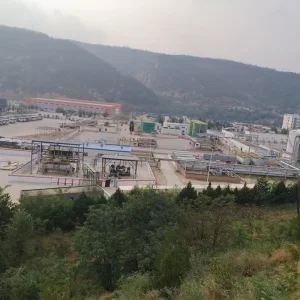
Manufacturing in China has evolved from raw production capacity to an integrated, smart ecosystem—often referred to as Industry 4.0. At our facility in Langfang City, Hebei, digital integration links raw material sourcing, automated steel rolling, high-precision robotic welding, and inline QA databases. This infrastructure offers clear benefits to global buyers:
- Raw Material Localization: High-quality alloy plates are sourced directly from leading mills with full EN 10204 3.1 certification, reducing raw material lead times to just days.
- Advanced Robotic Welding Stations: Automated welding ensures consistent weld profiles, minimizing human error and defect rates, which speeds up fabrication and reduces rework.
- Modular Production Capacity: Integrated assembly bays allow for the simultaneous fabrication, skid-mounting, piping, wiring, and testing of complex processing systems.
5. Macro-Industry Solutions: Gas Liquefaction, VOC, and Waste Treatment
Our systems are designed for high integration, enabling turnkey deployment in several critical applications:
Gas Purification & LNG Liquefaction
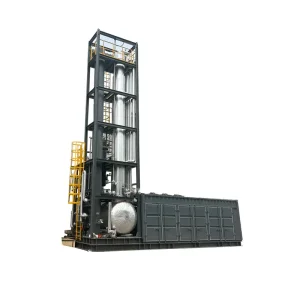
Skid-mounted systems engineered for desulfurization, deacidification, and cryogenic extraction of natural gas, shale gas, and coalbed methane.
VOC & Tail Gas Treatment
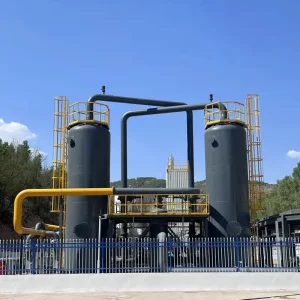
Thermal oxidizers and scrubbers designed to process toxic organic emissions and recover valuable tail gases like helium with zero leakage.
Medical & Biological Waste Treatment
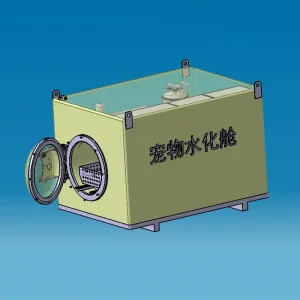
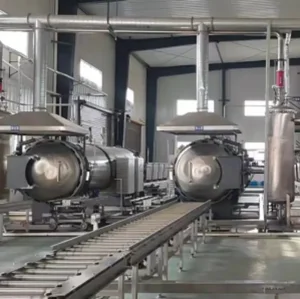
High-temperature steam sterilization systems designed for biological containment, treating medical waste and live toxic fluids safely and efficiently.
6. Global Compliance: ASME, PED, and GB Certification Frameworks
Operating pressure vessels globally requires strict compliance with regional safety laws. Our engineering team designs and manufactures equipment according to key international standards, ensuring seamless deployment and regulatory approval worldwide:
- ASME Section VIII Div. 1 & 2 (U & U2 Stamps): The standard for North American and global projects, verifying design integrity through rigorous stress analysis.
- PED 2014/68/EU (CE Marking): Complying with European Pressure Equipment Directive requirements, including ESR evaluations and Notified Body reviews.
- GB 150 (Chinese National Standard): Fully compliant with China's domestic safety codes, backed by our active A2-level manufacturing license.